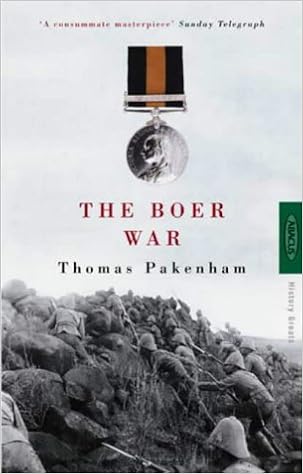
1979. New PB.
The Boer War 1899-1902
During the century since it took place, the South African War of 1899-1902 has never ceased to attract interest from the general public and debate amongst historians. Controversy over its origins, already underway when J.A. Hobson and L.S. Amery published their opposing interpretations in 1900, has continued ever since. Participants on both sides in the war found a ready market for their published accounts even before it was over, although some of the best were only published much later.
Amongst the many books written about this war by both amateur and professional historians, the best known is Thomas Pakenham's The Boer War, which has been a best-seller ever since it first appeared in 1979. Well-researched and engagingly written, Pakenham's account has deserved its success, despite sniffy reviews from some academic historians. The wealth of visual evidence available about this war - already indicated in the illustrated edition of his book which Pakenham published in 1993 - is well represented in some of the books under review, where many photographs are reproduced for the first time.
Tabitha Jackson's smoothly-written book will not satisfy professional historians, and is too neglectful of key aspects of the war to become the introductory text they will recommend to their students, but it draws substantially on the magnificent archive of visual material and oral testimony assembled by the Twenty Twenty Television team during the making of the four-part documentary film about this war to be screened on Channel 4 in the early autumn. Future historians of this war will have every reason to be grateful for the wide range of fresh material assembled over the past year in the course of this production. Meanwhile, as the book of the television series, this volume is likely to sell well.
David Smurthwaite has produced an excellent short, pictorial history of the war for the general reader. Well-organised, lavishly illustrated, it covers the main features of the war in a series of well-informed, succinct summaries and includes a useful Timeline. But it breaks new ground in the wealth of extracts from eye-witness accounts, both Boer and British, many of them unpublished, which make up more than half the text. Chosen with care, these give immediacy and substance to a book which is far more than a picture book and deserves to reach a wide audience. Its author (who is Assistant Director at the National Army Museum in London) neither avoids the fighting nor restricts his scope to military matters. He has supplemented British sources with material from collections in South Africa, where his book is also likely to be popular.
Field Marshal Lord Carver has produced a rather different kettle of fish from previously unpublished material in the archives of the National Army Museum. Dismissing any claim to 'a comprehensive or properly balanced history', he has plumped for a British view of the war as seen through the eyes of those participants whose letters and diaries happen to be in this archive. Roberts and Rawlinson are therefore well represented but Buller, White and Methuen (whose papers are elsewhere) are not. The strength of the book lies less in its narrative text than in the extensive extracts from ordinary soldiers' writings and the very direct way these convey what the war was actually like for Tommy Atkins. Testimony abounds to the poor provision for the British soldiers in this war: few tents, shared blankets, inadequate clothing, meagre rations, desperate thirst, huge distances marched through arid terrain in searing heat or drenching rain on an empty stomach, long night marches followed by poorly scouted military engagements, daylight hours spent immobilised under intense rifle-fire and a scorching sun amidst dead and dying comrades. The deadly exchanges of day-to-day warfare are graphically described along with the devastating results of poor field hygiene and inadequate medical provision (three quarters of British casualties were due to disease). The sense of blood-lust in battle and the intense satisfaction experienced after a successful skirmish are vividly conveyed, along with the score in killed and wounded. The courage, stamina and concern for their comrades exhibited by ordinary soldiers emerge clearly from these extracts along with a remarkably cheerful and philosophical acceptance of the harsh conditions under which they did their duty.
As the most costly and extensive war fought by Britain between 1815 and 1914, this war was certainly no picnic. The poor opinion of Lord Roberts for most of his military subordinates is largely shared by Lord Carver. But his figures for a war which he describes as 'an expensive failure' which should never have taken place, follow the 'official' British figures published shortly afterwards and take little account of much recent scholarship which has convincingly revised them.
Although Kitchener's complacency about the conditions in the concentration camps established by the British for Boer civilians is starkly revealed, Lord Carver himself seems to believe that these camps were set up more as a humanitarian measure than as part of a military strategy to win what had become a guerrilla war. He underestimates the numbers of Boers who died in these camps (the accepted figure is between 27,000 and 28,000) and he totally omits the existence of, and deaths in the parallel camps established for Africans (now estimated at 20,000). The role of Africans generally in this war, which has been the subject of much recent research, receives scant recognition. Still, this is a book essentially for military buffs, who will relish the military detail and the range of extracts from material in the National Army Museum which it makes available to a wider audience.
Bill Nasson's book, written as a volume in a series on Modern Wars, is likely to become the established text for students of this war wherever it is taught in universities.
It is well-informed, from sources in both Afrikaans and English, and absolutely up-to-date with the latest research. Whilst it deals crisply and adequately with the actual fighting, his book is more than a military history and nicely contextualises the war not only in terms of 'the Anglo-Boer crisis' in South Africa, at the end of the nineteenth century, but also within the wider frameworks of South African history, British society and the British Empire at that time. It is a good synthesis, having something to say about most aspects of the war, including how it was reported and received in Britain itself and what the attitudes and beliefs were of those who were involved in it. It is a densely written account, which avoids the highly personalised approach of Thomas Pakenham and has little space for eye-witness quotations, but it conveys a wealth of accurate information in a lively style with playful verbs and a taste for irony. Although devoid of illustrations, it has some excellent maps of the military deployments at the major battles, each of which is crisply and succinctly described. Nasson includes, at many points, the widespread involvement of the African population in what was certainly not just a white man's war and became a war with civil war dimensions to it. War went on at many different levels in South Africa, between 1899 and 1902, and there were other battlefields apart from those which have so preoccupied military historians. Many of the conflicts which then erupted into open warfare were home-grown, internally generated out of the recent South African past.
Nasson's book has many layers to it. Some will feel that it is too even-handed, and regret the loss of peaks and troughs. Others will feel short-changed by the matter-of-fact summaries accorded to the Brandwater Basin and the legendary exploits of leaders like Smuts and De Wet. This is an account with no heroes and precious few villains. But it is good, sound history.
With Fransjohan Pretorius's prize-winning book (this is an English translation of a book originally published in Afrikaans in 1991) the reader is presented with a work of genuine scholarship on a specific theme which will at once be welcomed by English readers who have hitherto had to rely largely on Deneys Reitz's classic account, Commando (1929) to learn what life on commando was really like during what Pretorius insists on calling the Anglo-Boer War. Here, one of South Africa's leading historians demonstrates just what old-fashioned, empirical history can achieve, to a generation of historians (and their students) too easily blown hither and yon by passing breezes of caprice and theory. This is a book based on painstaking, wide-ranging research and it radiates an authority and grasp of its material that one soon learns to trust. At every point, its conclusions are underpinned by evidence; and where the evidence is thin or non-existent, the author clearly indicates what can, and cannot be concluded.
On the larger issues of interpretation, as well as on the precise matters of facts, dates and figures, here is a book to be grateful for. Pretorius opens up the daily facts of life, for those on commando, in a fresh and engaging way and then goes on to analyse key themes in a series of well-constructed chapters dealing with provisions and food supply, clothing, tents, arms, ammunition, horses, recreations, religious beliefs, the matter of military discipline in a citizen army, group and social relations, attitudes towards and contact with Africans, foreign volunteers, women, the fierce and determined fight to preserve the independence of the Boer republics against the khakies and the reasons for finally accepting that the bitter end had been reached at Vereeniging in May 1902. Not content with conveying what the situation on commando was, and how it changed during the course of the war, Pretorius also explores how the war was experienced and interpreted, by those on commando, through their mostly unpublished writings. This is a substantial book, clearly organised, well-translated, which breaks new ground for the English reader. In South Africa it has long since established itself as the standard source on the subject. This is a book - this is history - which will last.
Amongst the many books written about this war by both amateur and professional historians, the best known is Thomas Pakenham's The Boer War, which has been a best-seller ever since it first appeared in 1979. Well-researched and engagingly written, Pakenham's account has deserved its success, despite sniffy reviews from some academic historians. The wealth of visual evidence available about this war - already indicated in the illustrated edition of his book which Pakenham published in 1993 - is well represented in some of the books under review, where many photographs are reproduced for the first time.
Tabitha Jackson's smoothly-written book will not satisfy professional historians, and is too neglectful of key aspects of the war to become the introductory text they will recommend to their students, but it draws substantially on the magnificent archive of visual material and oral testimony assembled by the Twenty Twenty Television team during the making of the four-part documentary film about this war to be screened on Channel 4 in the early autumn. Future historians of this war will have every reason to be grateful for the wide range of fresh material assembled over the past year in the course of this production. Meanwhile, as the book of the television series, this volume is likely to sell well.
David Smurthwaite has produced an excellent short, pictorial history of the war for the general reader. Well-organised, lavishly illustrated, it covers the main features of the war in a series of well-informed, succinct summaries and includes a useful Timeline. But it breaks new ground in the wealth of extracts from eye-witness accounts, both Boer and British, many of them unpublished, which make up more than half the text. Chosen with care, these give immediacy and substance to a book which is far more than a picture book and deserves to reach a wide audience. Its author (who is Assistant Director at the National Army Museum in London) neither avoids the fighting nor restricts his scope to military matters. He has supplemented British sources with material from collections in South Africa, where his book is also likely to be popular.
Field Marshal Lord Carver has produced a rather different kettle of fish from previously unpublished material in the archives of the National Army Museum. Dismissing any claim to 'a comprehensive or properly balanced history', he has plumped for a British view of the war as seen through the eyes of those participants whose letters and diaries happen to be in this archive. Roberts and Rawlinson are therefore well represented but Buller, White and Methuen (whose papers are elsewhere) are not. The strength of the book lies less in its narrative text than in the extensive extracts from ordinary soldiers' writings and the very direct way these convey what the war was actually like for Tommy Atkins. Testimony abounds to the poor provision for the British soldiers in this war: few tents, shared blankets, inadequate clothing, meagre rations, desperate thirst, huge distances marched through arid terrain in searing heat or drenching rain on an empty stomach, long night marches followed by poorly scouted military engagements, daylight hours spent immobilised under intense rifle-fire and a scorching sun amidst dead and dying comrades. The deadly exchanges of day-to-day warfare are graphically described along with the devastating results of poor field hygiene and inadequate medical provision (three quarters of British casualties were due to disease). The sense of blood-lust in battle and the intense satisfaction experienced after a successful skirmish are vividly conveyed, along with the score in killed and wounded. The courage, stamina and concern for their comrades exhibited by ordinary soldiers emerge clearly from these extracts along with a remarkably cheerful and philosophical acceptance of the harsh conditions under which they did their duty.
As the most costly and extensive war fought by Britain between 1815 and 1914, this war was certainly no picnic. The poor opinion of Lord Roberts for most of his military subordinates is largely shared by Lord Carver. But his figures for a war which he describes as 'an expensive failure' which should never have taken place, follow the 'official' British figures published shortly afterwards and take little account of much recent scholarship which has convincingly revised them.
Although Kitchener's complacency about the conditions in the concentration camps established by the British for Boer civilians is starkly revealed, Lord Carver himself seems to believe that these camps were set up more as a humanitarian measure than as part of a military strategy to win what had become a guerrilla war. He underestimates the numbers of Boers who died in these camps (the accepted figure is between 27,000 and 28,000) and he totally omits the existence of, and deaths in the parallel camps established for Africans (now estimated at 20,000). The role of Africans generally in this war, which has been the subject of much recent research, receives scant recognition. Still, this is a book essentially for military buffs, who will relish the military detail and the range of extracts from material in the National Army Museum which it makes available to a wider audience.
Bill Nasson's book, written as a volume in a series on Modern Wars, is likely to become the established text for students of this war wherever it is taught in universities.
It is well-informed, from sources in both Afrikaans and English, and absolutely up-to-date with the latest research. Whilst it deals crisply and adequately with the actual fighting, his book is more than a military history and nicely contextualises the war not only in terms of 'the Anglo-Boer crisis' in South Africa, at the end of the nineteenth century, but also within the wider frameworks of South African history, British society and the British Empire at that time. It is a good synthesis, having something to say about most aspects of the war, including how it was reported and received in Britain itself and what the attitudes and beliefs were of those who were involved in it. It is a densely written account, which avoids the highly personalised approach of Thomas Pakenham and has little space for eye-witness quotations, but it conveys a wealth of accurate information in a lively style with playful verbs and a taste for irony. Although devoid of illustrations, it has some excellent maps of the military deployments at the major battles, each of which is crisply and succinctly described. Nasson includes, at many points, the widespread involvement of the African population in what was certainly not just a white man's war and became a war with civil war dimensions to it. War went on at many different levels in South Africa, between 1899 and 1902, and there were other battlefields apart from those which have so preoccupied military historians. Many of the conflicts which then erupted into open warfare were home-grown, internally generated out of the recent South African past.
Nasson's book has many layers to it. Some will feel that it is too even-handed, and regret the loss of peaks and troughs. Others will feel short-changed by the matter-of-fact summaries accorded to the Brandwater Basin and the legendary exploits of leaders like Smuts and De Wet. This is an account with no heroes and precious few villains. But it is good, sound history.
With Fransjohan Pretorius's prize-winning book (this is an English translation of a book originally published in Afrikaans in 1991) the reader is presented with a work of genuine scholarship on a specific theme which will at once be welcomed by English readers who have hitherto had to rely largely on Deneys Reitz's classic account, Commando (1929) to learn what life on commando was really like during what Pretorius insists on calling the Anglo-Boer War. Here, one of South Africa's leading historians demonstrates just what old-fashioned, empirical history can achieve, to a generation of historians (and their students) too easily blown hither and yon by passing breezes of caprice and theory. This is a book based on painstaking, wide-ranging research and it radiates an authority and grasp of its material that one soon learns to trust. At every point, its conclusions are underpinned by evidence; and where the evidence is thin or non-existent, the author clearly indicates what can, and cannot be concluded.
On the larger issues of interpretation, as well as on the precise matters of facts, dates and figures, here is a book to be grateful for. Pretorius opens up the daily facts of life, for those on commando, in a fresh and engaging way and then goes on to analyse key themes in a series of well-constructed chapters dealing with provisions and food supply, clothing, tents, arms, ammunition, horses, recreations, religious beliefs, the matter of military discipline in a citizen army, group and social relations, attitudes towards and contact with Africans, foreign volunteers, women, the fierce and determined fight to preserve the independence of the Boer republics against the khakies and the reasons for finally accepting that the bitter end had been reached at Vereeniging in May 1902. Not content with conveying what the situation on commando was, and how it changed during the course of the war, Pretorius also explores how the war was experienced and interpreted, by those on commando, through their mostly unpublished writings. This is a substantial book, clearly organised, well-translated, which breaks new ground for the English reader. In South Africa it has long since established itself as the standard source on the subject. This is a book - this is history - which will last.

No comments:
Post a Comment