THE BATTLE OF BRITAIN – Review by Mark Barnes
| SHARE:FacebookTwitter |
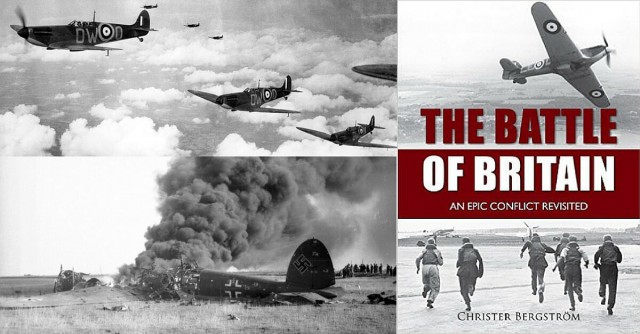
A recent book I reviewed was about the Battle of Britain and here we are again with yet another. It really is a case of ‘we shall fight them in the bookshops’ during this seventy-fifth anniversary year of the series of events that made up the epic battle. I have others to look at.
Here we have a really rather neat and considered piece of work by Christer Bergstrom, an author who has spent many years researching facts and collating conversations with some of the men who took part, including many top names.
The book takes us through the battle in some details along with a reassessment of significant features and statistics. We are treated to comparisons of the major aircraft and look at some important characters in addition to a diary of events with descriptions of major incidents from specific days.
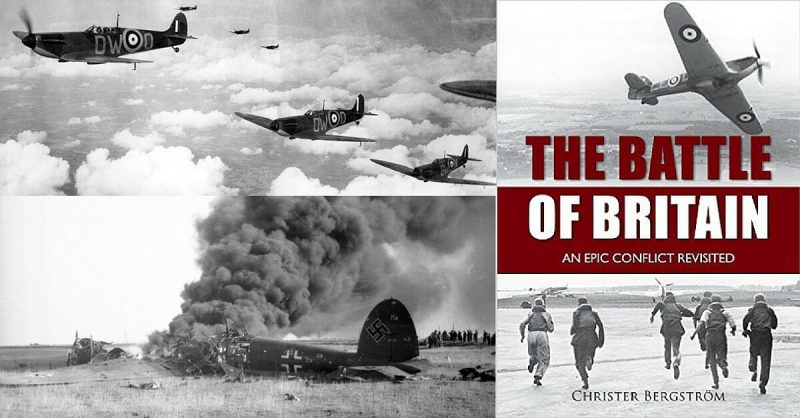
This is a wide-ranging book looking at all aspects of the battle and brings it together in a single attractive package. The book promises rarely seen images and while there are many old favourites I noted a good number I had not seen previously. It looks good and feels substantial. Right from the off when we see Stanley Devon’s classic image of three Hurricanes converging on a Fairey Battle it is easy to presume we will be in safe hands and this seems to be the case.
There really isn’t much I can add to the Battle of Britain story. I grew up with it from a young age and pictured many of the RAF heroes of the battle as little more than gods. I loved the planes and the drama and followed it via films, war comics, Dinky toys and model kits. It was at a time when footballers were becoming a little more celebrated and the only big stars were musicians or in the movies. Our Battle of Britain heroes were not famous in the context of people who bake cakes on the telly but they were marked as heroic and that is a different kind of fame altogether. We rarely see people like it nowadays because our celebrity culture is so ingrained in ‘journeys’ and all those other dodgy descriptions for just getting on with things.
I have never met any participants from the battle but have been a semi-assiduous gatherer of books about it since I read Peter Townsend’s Duel of Eagles as a teenaged kid marooned in a village near Clonmel a million summers ago. Visits to the RAF Museum at Hendon were always a joy and any time I hear a Merlin engine I still sprint out into my back garden to see what has taken off from my local airport. Only the other day a couple of lovely Spitfires thundered over
The author of this book will probably identify with much I have said about my feelings for the battle. He retains a carefully neutral view of events and I guess this reflects the wave of respect there is for pilots on both sides nowadays. Although the battle remains the source of immense pride here in sunny Britain
our connection with it, like so much else, is fading. Facts emphasise that for all it meant to my country it was a genuinely international event with participants coming from far and wide. While I am not trying to make it sound like a sports event, it illustrates what a polyglot of nationalities the RAF was becoming as early as the summer of 1940. Mr Bergstrom offers respect to all of them.
I like this book. It has a cool design and goes together well. The translation from the original Swedish by Donald Bryant and Louise Stromback flows along nicely.
The use of illustrations is handled with care and not a little style. It doesn’t feel like an English book and clearly it isn’t. I guess the big question is how well it will fair in the blizzard of other B of B titles that are out there. There are three more on my ‘to do’ pile. The Battle of Britain will never go away, a fact I imagine pleases a lot of people all over the planet. Mr Bergstrom gives a good account of it and if you are looking for an image heavy one-stop history this might be all you need.
Reviewed by Mark Barnes for War History Online
As anniversaries go, the seventy-fifth of the Battle of Britain was obviously a big one. There were ceremonies and epic flypasts and decent, occasionally well-informed, coverage in the media. Add in a few new books and any enthusiast had it made, particularly if they lived in the UK. Off the top of my head, I can’t think of many new titles on the subject although there were clearly a few. The hardcover edition of Helen Doe’s Fighter Pilot and the Pen & Sword edition of Australia’s Few and the Battle of Britain by Kristen Alexander come to mind but that’s it at the moment. I think that’s probably because I didn’t pay much attention because I spent a fair bit of time with my nose in what just might be the final word on this most famous of aerial battles. Christer Bergström spent more than four decades gathering material for The Battle of Britain, An Epic Conflict Revisited, and it shows. This must surely be one of the last books to be released that will use original, unpublished veteran interviews as source material.
Right from the start the author makes his intentions clear. The BoB, being entrenched in popular culture as it is, is one of those periods of history where myths and half-truths evolve into apparent fact and are spouted left, right and centre by anyone with a passing interest. Alongside legendary exploits such as the Dams raid and the Doolittle raid, the Battle of Britain grabs the attention. There are tales of derring-do on both sides, Britain with its back against the wall, a rampaging Germany stopped in its tracks. It’s stirring stuff and, best of all, it really did happen. Who needs fiction when history is so much better? As time goes on, however, and these things are analysed ad nauseum and different opinions and conclusions put forward, even movies made, the line between fact and fiction starts to blur and some of the ‘faction’ starts to become accepted or even common knowledge and is certainly not helped by being regurgitated by the media. You know about the BoB, you wouldn’t be reading this otherwise. Have a think about these half-truths. What comes to mind? Göring was a bumbling fool. Fighter Command stood alone. The Bf 110 was a sitting duck against the Spitfires and Hurricanes. You know the drill. Bergström sets about proving these to be wrong. Göring, while clearly a man who enjoyed the finer things in life, was an old fighter pilot, and a successful one at that. He related well with his fighter units and understood their desire, their need, to hunt. He was not a fan of tying the fighters to the bombers but had to keep his bomber group commanders happy. He did allow his fighters to go on free hunting sweeps ahead of the day’s bombing raids and these were successful until Fighter Command cottoned on that there were no bombers in the incoming radar plots. It was Göring who had fresh fighter formations, those that had not flown on the returning raids, cover the withdrawal across the Channel. He proved insightful, adaptable and trusting of his men. He had his finger on the pulse but, ultimately, with a rather large commitment to the east requiring attention, the Italians in the Mediterranean needing reinforcing, not to mention a fair bit of angst among his commanders who did not implement his directives in full, he was up against it to achieve the required result especially when the RAF proved so hard to dislodge.
It was such a close run thing, though. Some of the loss statistics are harrowing and you have to remember that there is at least one man involved in each of those aircraft lost. Even in October, when many regard the Battle as more or less having run its course, the Germans shot down more aircraft than the RAF did. At the time much of the daylight activity was centred around fighters escorting fighter bombers in an attempt to draw the RAF up. Within six months, the RAF was trying to do the same thing to the Luftwaffe over occupied Europe. Contrary to popular belief, the RAF suffered at the hands of the Bf 110 crews. It had the range and firepower to be an absolute menace particularly when working in concert with several other ‘110s. As someone who doesn’t read a lot about the BoB, I was consistently surprised, and somewhat disturbed, at the number of Spitfires and Hurricanes that fell to the guns of the big fighter. Some of the Zerstörer units, some of the Luftwaffe’s most effective offensive units, had better kill/loss ratios than some of the Bf 109 units. While units on both sides, and flying all types, were withdrawn to regroup, it was surprising how truly ineffective some of the Luftwaffe’s single engine fighter groups were. It’s not a viewpoint I’ve come across before, partly because of the dearth of recent reading on the subject, but the analysis is due to the author getting to grips with German records.
It is pleasing to see Bomber Command receive regular attention as the author progresses through the timeline. More than just hitting the invasion barges in the Channel ports, the Whitleys, Hampdens, Blenheims and Wellingtons were taking the fight to Germany itself. While they were mere pinpricks compared to what the Germans achieved with their bomber formations, they were a nuisance that led to at least one Bf 110 unit being withdrawn for a rest and conversion to night fighting.
This is as good a discussion of the progression of the BoB as I’ve ever read. It includes the usual formation numbers on such and such a date and losses for the day as expected but, like some books before it, it includes a surprising amount of recollections from the pilots themselves. Again, nothing really new there but these are the product of the author’s own interviews and many were recorded decades ago. Of course, many of the men interviewed are no longer with us.
Chapters are split roughly in to months and the narrative is incredibly detailed when it comes to looking at the machinations of the German hierarchy behind the scenes. The whole thing was really theirs to lose.
This is a book that everyone who is interested in the period should have on their shelf. It is critical, but fair, and pulls no punches. The author is not backwards in coming forwards when it comes to discrediting accepted truths and it is a testament and tribute to his decades of work that everything about the analysis, discussion and conclusions is supported by the most comprehensive bibliography, using sources from both sides (some of which would rarely see the light of day, I imagine), that I have seen. The range of photos used is second to none and include a stunning colour photo section and the ubiquitous profiles. Many of the captions are long and provide excellent detail.
The aircraft are introduced at the start and, weirdly, the Westland Whirlwind is mentioned but the Bristol Beaufighter is not. It’s the first time I’ve seen the Whirlwind included as one of the aircraft that contributed to the Battle of Britain. There are long passages for the Spitfire and the Messerschmitts, little on the Hurricane and the Defiant receives as much attention as the Whirlwind. As great as this book is, this is just one of the odd little things within its pages (and let's not go in to the 'modern' Hurricane on the cover!).
Continuing in this vein, this book needs an edit. A serious edit. It was originally written and published in Swedish and may (I do not know) have been translated in to English by the author. I very much doubt whether this English translation was edited because it really does appear that it wasn’t. There are clumsy sentences and statements where the order of the words is wrong or extra words are included. This occurs on every page. I raised this as I was reading it. Some were not concerned as they felt it took nothing away from the book, and they’re right, while others found it distracting. On top of those opinions, all of which I agreed with, I don’t think it honours the work of the author. Here’s a man who has spent more than forty years collating the material to produce a gem of a book only to have it tarnished by many apparent oversights post-manuscript submission. A full read through edit would have picked up some errors in the captions and some minor double-checking of details in the narrative. I would have no hesitation calling this book the ultimate discussion of the BoB if these errors and oversights were cleared up (and I have a list!) because it would then be near perfect. With luck a further print run or a second edition will clear this up but it will require a good dose of work that should have been done before the book was published.
Don’t let me put you off. This is the book on the Battle of Britain and this review isn’t intended to be a blow by blow account of the Battle or to approach the detail of the narrative. A large, A4 format of 330 pages and hundreds of photos, it takes into account all that have preceded it and gives credit where it is due. It is, however, an entirely original discussion, based on familiar knowledge, that goes beyond anything before it. It is mature, incredibly well-researched and insightful beyond belief.
Epic conflict. Epic book.
Andy Wright





 Comment
 British Pacific Fleet member Chris Cartledge pictured in front of a Royal Navy Corsair, IWM Duxford, April 21st, 2015 (Photo: Emilie Sandy)
 British carrier HMS Formidable moments before and after it is hit by a Kamikaze, May 4th 1945. (Fleet Air Arm Museum)
 Wally Stradwick in Miami in late 1943, soon after receiving his wings after learning to fly in America during the war
 Reunited after 70 years: HMS Formidable airmen (from left to right) Chris Cartledge, Roy Beldam and Keith Quilter (Pic: Emilie Sandy)